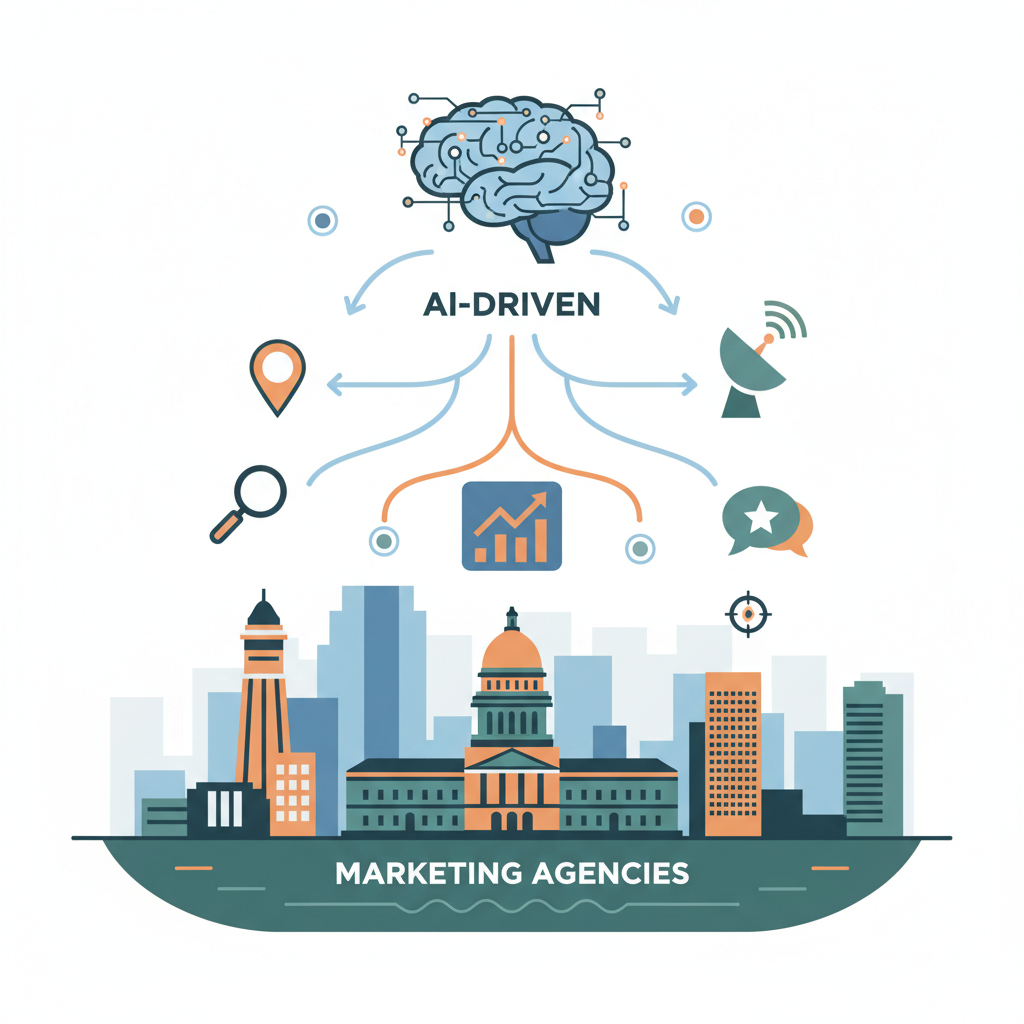
Your agency’s white-labeled reports are bleeding credibility because old-school rank trackers can’t keep up with how Denver locals actually search in 2026. It’s a data problem. You need the best AI-driven local visibility tools for Denver marketing agencies to bridge the gap between static keywords and the fluid reality of AI-driven search results. Static maps are dead. And agencies that ignore predictive analytics will quickly find their clients buried under competitors who embraced the machine learning shift early.
Why do Denver agencies need to prioritize AI-driven local visibility today?
Precision is everything. Denver is a hyper-competitive hub where a block’s distance from Union Station changes search intent. Your clients aren’t just looking for high rankings anymore. They want to appear in the AI Overviews and conversational snapshots that now dominate the top of every mobile screen across the Front Range. Traditional tools tell you where you were yesterday. But AI-driven local visibility tools tell you how to dominate the space where your customers are going tomorrow.
The local landscape has shifted. Search engines now parse natural language queries like where can I find the best gluten-free pizza near Coors Field right now with terrifying accuracy. If your agency still relies on manual keyword tracking, you’re missing the nuances of semantic search. Predictive modeling allows us to see how localized trends in neighborhoods like RiNo or Cherry Creek affect click-through rates. It’s about staying ahead. And that requires a stack built on neural networks rather than simple database lookups.
Efficiency matters for your margins. We’ve seen teams spend forty hours a month just cleaning up local listing data for a handful of clients. Automated intelligence handles that in seconds. By using the best AI-driven local visibility tools for Denver marketing agencies, we free up our strategists to do actual strategy. We stop fighting the software. We start winning the market. This is how Denver marketing agencies scale without ballooning their payroll costs in an expensive labor market like Colorado.
Which AI tools provide the most accurate local search intent data?
Context is king. To win in local SEO, you must understand the difference between a tourist looking for a landmark and a local looking for a service. AI tools like Profound have become essential because they provide engine-agnostic visibility across ChatGPT, Gemini, and traditional search. They don’t just track blue links. They track mentions, citations, and brand sentiment. These are the new ranking factors for 2026.
Semantics drive the engine. BrightLocal’s latest AI-powered insights engine now analyzes the sentiment of thousands of Google reviews simultaneously to suggest content pivots. It identifies that customers in the Highlands mention patio seating more often than those in Wash Park. You can use this data. It’s pure reputation gold. You can adjust your client’s Google Business Profile descriptions to reflect those hyper-local preferences before the competition even notices the shift in consumer behavior.
Data tells a story. We look toward Surfer SEO’s localized auditing features to ensure our landing pages are perfectly tuned for Denver-specific search clusters. It compares your client’s site against the top ten performers in the local Map Pack. It suggests exact word counts. It identifies missing LSI keywords. But most importantly, it uses NLP (Natural Language Processing) to ensure the tone matches what Denverites actually want to read: active, outdoor-focused, and direct language.

How can agencies automate hyper-local content creation for multiple locations?
Scalability is a hurdle. When you manage a client with twenty locations across the Denver metro area, writing unique content for each feels impossible. This is where Jasper and Claude 3.5 Sonnet come into play with their regional memory features. You provide the local landmarks. The AI generates the localized context. It’s not just cookie-cutter nonsense that sounds like a robot wrote it.
Quality remains the priority. The best AI-driven local visibility tools for Denver marketing agencies prioritize E-E-A-T (Experience, Expertise, Authoritativeness, and Trustworthiness) by citing real-world data points. We use AI agents to scrape local news from The Denver Post or Westword to find relevant community events. Then we weave these into localized blog posts. This makes your site BFFs with search crawlers because your content is genuinely fresh and locally relevant.
Structure your data properly. Schema Markup is arguably the most critical yet overlooked part of local visibility. AI-driven platforms like Hike SEO or Yext now auto-generate JSON-LD code that specifically targets local entities. They tell search engines exactly where the front door is. They confirm the NAP (Name, Address, Phone Number) data across the entire web. This no-nonsense approach creates a robust foundation for any Denver digital marketing strategy.
What are the best ways to track AI-generated search results in Denver?
Visibility is evolving. In 2026, being Number 1 on a SERP (Search Engine Results Page) is often less valuable than being the primary citation in a Search Generative Experience (SGE) answer. Platforms like Keyword.com now offer AI Visibility tracking. They show you exactly which AI snapshots feature your client. They even alert you when a competitor moves in on your territory. It is like a detective with a magnifying glass for your local rankings.
Monitor the Map Pack constantly. Tools like Local Falcon use a geogrid system to show you exactly how ranking changes as you move through city streets. You can see a ranking drop at 17th and Blake while remaining strong at 20th and Market. AI then analyzes these spatial patterns. It suggests if the issue is a lack of locally-themed backlinks or perhaps a high bounce rate from specific mobile devices used in those areas. It turns feedback into reputation gold by highlighting exactly where to focus your optimization energy.
Analyze the unnatural patterns. Large Language Models can sometimes hallucinate local data. We use AI-driven auditing tools to ensure that the information being fed to ChatGPT and Gemini is accurate. If an AI tool thinks your client’s law firm is in Aurora when it’s in LoDo, you have a visibility crisis. Correcting these knowledge graph errors is the next-level skill Denver agencies must master this year. It’s about squash the bugs before they ruin your client’s conversion rates.
How does predictive AI help with Denver seasonal marketing trends?
Anticipate the shift. Denver’s economy fluctuates with the seasons: ski season, hiking season, and the summer concert rush at Red Rocks. Predictive AI tools analyze years of local search volume to tell us exactly when to launch PPC campaigns. We don’t guess. We use pure data nerdiness to allocate budgets. If the data shows an early interest in snow removal in September, we’re already prepared with optimized landing pages.
Stay ahead of the competition. While other agencies are reacting to Google Trends, we are using AI models like Pecan or Similarly to forecast demand. We look at weather patterns and local economic indicators. We even factor in Denver airport traffic data for our travel and tourism clients. Using the best AI-driven local visibility tools for Denver marketing agencies means we are always the first to nail those seasonal peaks. Our clients’ calendars stay full while their competitors are still alphabet soup searching for answers.
Personalize the customer journey. AI doesn’t just find the customer. It understands their intent cycle. A user searching for a Denver roofing company after a hailstorm has a different urgency score than someone looking for a routine inspection. AI allows us to serve dynamic content based on that urgency. We change the CTA (Call to Action) from Get a Quote to Emergency Service Available automatically. This not just some generic email or landing page logic: it’s conversion-focused reality.
Can AI tools manage bulk reputation management for local businesses?
Reviews are the lifeblood of local SEO. For an agency, managing hundreds of reviews across multiple platforms is a logistical nightmare. AI-driven reputation tools like Birdeye or Podium now use natural language generation to draft intelligent responses. These aren’t cookie-cutter templates. They address the specific pain points mentioned in the review. They use the customer’s name and reference the service provided.
Speed builds trust. When a 1-star review hits a client’s Google profile in the middle of the night, AI monitors flag it immediately. They can even suggest a diplomatic resolution based on successful past interactions. This move the needle for local rankings because Google rewards active profile management. You’re not just ignoring the noise. You are turning feedback into reputation gold every single day.
Sentiment analysis is deep. We use AI to look for linguistic patterns in reviews that indicate a systemic issue. If multiple customers in the Tech Center complain about late arrivals but those in Arvada do not, the AI highlights the geographic discrepancy. We can then provide our client with actionable insights regarding their operations. We become a business consultant, not just a marketing agency. That’s how you make your site BFFs with the business owner’s bottom line.
How do you measure ROI with AI-powered local visibility stacks?
Metrics must be tangible. We’ve moved past simple impression counts. Modern AI dashboards integrated with GA4 allow us to attribute store visits and phone calls directly to specific local visibility efforts. We can see the full-body checkup of a campaign’s health in real-time. If a local ad isn’t moving the needle on conversions, the AI reallocates the budget into high-performing zip codes like 80202 or 80206 automatically.
Transparency is key. Our Denver marketing agency uses AgencyAnalytics with AI-generated summaries. It explains the why behind the numbers. Instead of a confusing spreadsheet, the client gets a concise narrative. It tells them: Your visibility in Boulder increased because we optimized for conversational search terms. This builds long-term trust. It removes the no smoke, no mirrors doubt that often plagues digital marketing relationships.
Focus on customer lifetime value. AI helps us identify which local searchers are likely to become repeat customers. We look at behavioral data. We track how users interact with local listings over time. By using the best AI-driven local visibility tools for Denver marketing agencies, we ensure our clients aren’t just getting one-off clicks. They are building a loyal local base. This is the result of pure data nerdiness applied to street-level marketing.
What are the common pitfalls of using AI for local visibility?
Avoid over-automation. It’s tempting to let the AI run everything. But local search requires a human touch. AI might not understand a local Denver news joke or a Broncos reference. If your content sounds too robotic, you’ll lose the trust of the community. Use AI as a co-pilot, not the sole driver. Always have a human editor review the localized content before it goes live.
Watch out for data silos. If your reputation tool doesn’t talk to your listing manager, you’re missing the synergy. Use integrated platforms. Ensure your AI stack shares data points across all visibility channels. A holistic view is the only way to nail those complex multi-location campaigns. Don’t fall for flashy features that don’t solve actual agency problems like reporting fatigue or data entry errors.
Check the accuracy. AI can sometimes invent local citations or backlinks that don’t exist. We perform a full-body checkup on our AI-generated reports every week. We verify that the local directories the AI mentions are high-authority and relevant. No guesswork is allowed when it comes to a client’s online reputation. You must be like a detective with a magnifying glass when checking AI work to maintain professional standards.
Frequently Asked Questions About Local Visibility Tools
- How often should we update our Denver local listings using AI?
We recommend a weekly sync. Local data changes fast. AI handles this seamlessly, but you should still review for accuracy. - Is AI-driven SEO more expensive than traditional SEO?
Initially, yes. The software costs are higher. But the ROI is vastly superior because it saves hundreds of labor hours and targeting is far more precise. - Can AI help my Denver legal or medical clients rank better?
Yes. It’s game-changing for YMYL (Your Money Your Life) industries. AI ensures all credentials and citations are flawless across the web, which is critical for trust. - Will Google penalize my site for using AI-generated local content?
Not if it’s high quality. Google rewards helpful content. As long as your AI-driven local visibility tools produce value for Denver searchers, you are safe.
Master the Denver search landscape with intelligent automation
Success is here. You now have the blueprint for selecting the best AI-driven local visibility tools for Denver marketing agencies to outperform the competition. Don’t wait for your clients to ask about AI search snapshots. Lead the conversation. Show them you have the data and the tools to place them exactly where their customers are looking. It’s time to stop the guesswork and start dominating the local grid.
Take the next step. Audit your current software stack immediately. Identify the manual bottlenecks. Replace them with intelligent agents that can scale. Whether you’re targeting LoDo, Cherry Creek, or the surrounding suburbs, the machine learning advantage is yours to take. Let’s be real: the future of Denver marketing isn’t just digital. It’s AI-powered, and it’s happening right now.